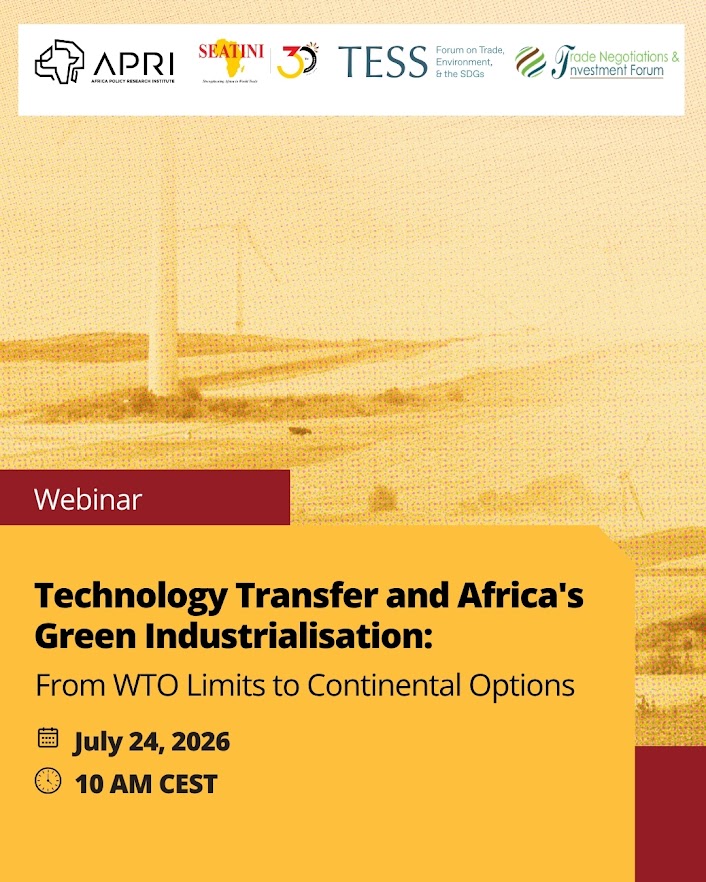

This webinar explores policy pathways to strengthen technology transfer, maximise the AfCFTA’s industrial potential and position Africa within evolving WTO digital trade frameworks.
Background
Africa’s industrialisation agenda is being reshaped by the green transition, digitalisation, evolving climate-related trade measures, growing demand for critical minerals, and renewed industrial policy across major economies. For African countries, the question is no longer whether green industrialisation matters. The more urgent question is how Africa can convert its resources, markets, young population, and regional integration agenda into productive capacity, greater value addition, and resilient green value chains.
Technology transfer sits at the centre of this agenda. For African industrialisation, technology transfer must include access to relevant technologies, the capacity to adapt and maintain them, the skills to use them productively, the ability to innovate locally, the infrastructure to deploy them at scale, and the legal and investment frameworks that make technology diffusion commercially viable and development-oriented.
The multilateral context remains relevant, but this conversation is framed far beyond this. A useful entry point is the evolving legal and policy architecture for digital trade, technology diffusion and industrial development. In that regard, the WTO Agreement on Electronic Commerce and the pathway announced by supporting Members during MC14 to bring it into force are significant. This is because digital trade rules will shape the practical rails through which green technologies, services, data, payments, authentication systems, standards information and business-to-business transactions move across borders. The Agreement should therefore be discussed as part of the wider infrastructure for technology-enabled industrialisation.
At the same time, Africa has important continental tools that can be used more strategically. The AfCFTA, through its protocols on investment, intellectual property and digital trade, provide a platform for coordinating industrial policy, encouraging investment linked to technology and skills transfer, strengthening regional value chains, supporting digital industrialisation, and shaping common African positions in global trade governance
The Event
APRI’s Just Green Technology Transitions Programme, in partnership with the Trade Negotiations & Investment Forum (TNIF), the Forum on Trade, Environment, & the SDGs (TESS), and SEATINI Uganda, is hosting this webinar. The event seeks to explore ways to strengthen the multilateral trading system to facilitate technology transfer and provide the policy flexibility needed for African industrial strategies. A key focus will be on how African nations can maximise existing opportunities to acquire and localise essential technologies. The session will analyse the collective role of the AfCFTA’s digital trade, investment, and intellectual property protocols in driving this transition and examine how WTO digital trade and e-commerce regulations will influence Africa’s positioning in green technology sectors.
Speakers
Event moderated by Dr. Serwah Prempeh.

Ambassador Amina Mohamed
Chairperson, Trade Negotiations and Investment Forum

Janet Macharia
Chief Executive Officer, Trade Negotiations and Investment Forum

Christophe Bellmann
Head of Policy Analysis and Strategy, Forum on Trade, Environment and the SDGs

Herbert Kafeero
Deputy Executive Director, SEATINI Uganda

Desire Loumou
Head of Division, Intellectual Property Rights, Africa Continental Free Trade Area Secretariat

Vicente Paolo Yu
International Lawyer and Independent Consultant

Dr. Serwah Prempeh
Senior Fellow and Head of Just Green Technology Transition Programme, APRI – Africa Policy Research Institute